A bulb used as food
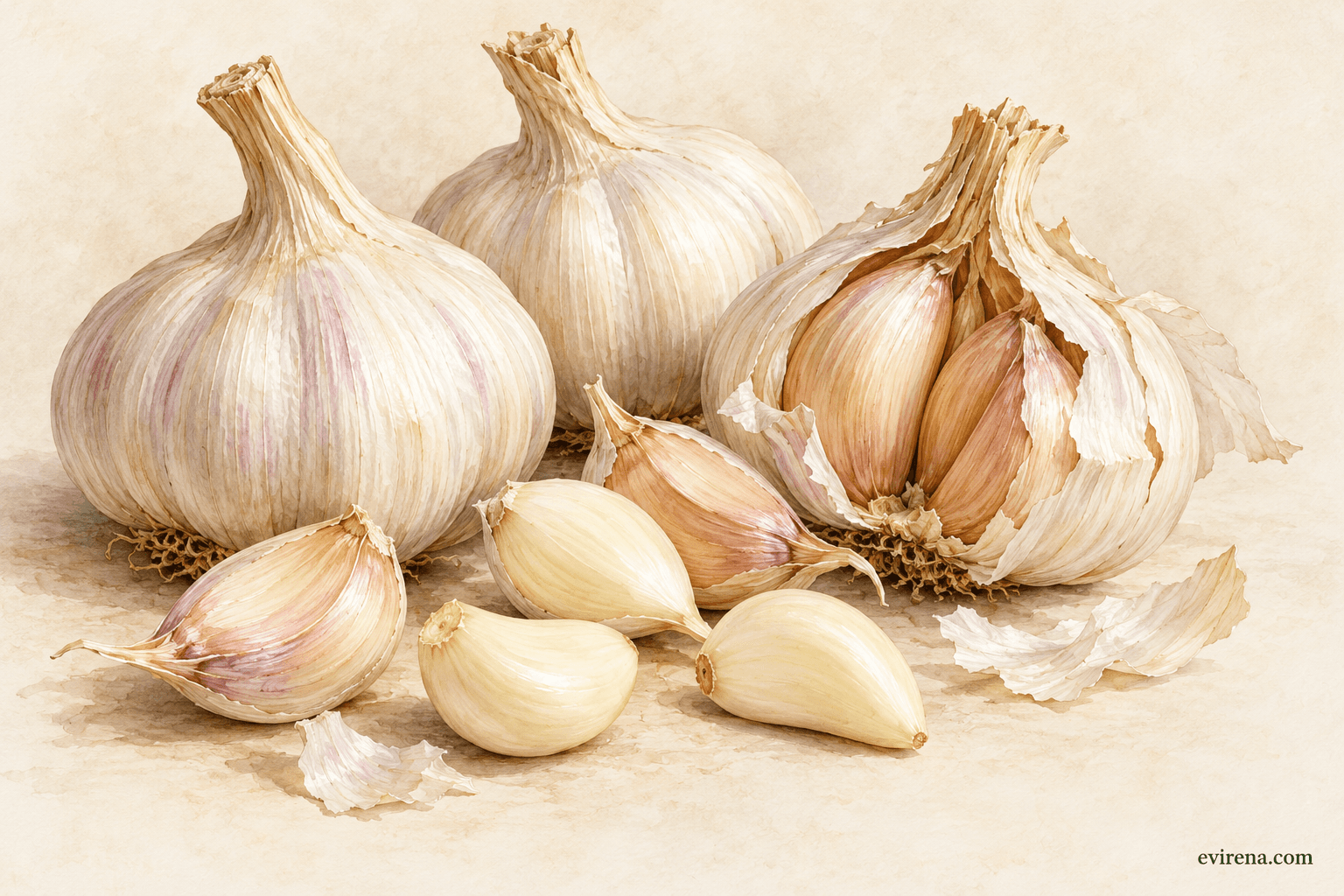
Garlic, Allium sativum, is a bulb-forming plant in the Amaryllidaceae family, related to onions, leeks and chives. Its familiar bulb separates into cloves. In cooking, the cloves are used raw or cooked to flavour dishes; the flower stalk, or scape, can also be eaten. These ordinary uses identify a food, not a standardized treatment. A culinary ingredient can have a long history without every health claim attached to it being established. NC State
Food and supplements are different preparations
Chopping or crushing garlic allows an enzyme to form allicin from alliin. Allicin then changes into other sulfur-containing compounds. Processing matters: powdered garlic tablets, aged extracts and distilled garlic oils have different chemical profiles. A capsule therefore cannot be assumed to reproduce either a cooked dish or another supplement. Laboratory activity of isolated compounds also does not show that eating garlic treats disease. Oregon State
What a cholesterol trial actually found
A randomized trial published in 2007 enrolled 192 adults aged 30–65 with moderately elevated LDL cholesterol, initially 130–190 mg/dL. It compared raw garlic, a powdered supplement, an aged extract and placebo over six months. The preparations were taken six days each week; the raw-garlic arm used approximately one 4-gram clove in food. These are study details, not a recommended dose. The materials were chemically characterized and blood lipids measured repeatedly. None of the three garlic preparations produced a statistically significant LDL reduction compared with placebo. Gardner et al.
The result applies to those preparations and participants. It does not establish that every garlic product is ineffective for every outcome. Conversely, favourable findings from other preparations cannot be transferred automatically to cooking with garlic. Participants could recognize raw garlic's taste, so that comparison was not fully blinded. Pregnant and breastfeeding people were excluded. The study measured blood lipids, not whether garlic prevented heart attacks. It gives no basis for replacing prescribed cholesterol treatment. Gardner et al.
Medicines, allergy and other cautions
Garlic can cause digestive discomfort, and allergic reactions are possible. Prolonged application of raw garlic to skin can cause burns; it should not be used as a home skin treatment. Reports of bleeding have been associated with supplements, but case reports cannot by themselves establish causation or show how often this occurs. Before using a supplement, discuss anticoagulants such as warfarin, medicines affecting platelets and planned surgery with a clinician or pharmacist. Preparations differ, and some monitored studies have not found increased bleeding. Oregon State
A separate small interaction study enrolled ten healthy volunteers and gave garlic caplets for three weeks. Average exposure to the HIV medicine saquinavir, measured as the blood concentration–time area, decreased by 51% during garlic use. This was a study of a particular supplement and drug regimen, not a trial of everyday food or all HIV medicines, and it did not measure treatment failure. It supports checking the exact product and medicines rather than assuming an herbal supplement cannot interact. Piscitelli et al.
Oregon State University distinguishes dietary garlic from supplements whose safety in pregnancy has not been established. During pregnancy or breastfeeding, discuss supplement use with a healthcare professional instead of assuming familiarity as food proves its suitability. Anyone with a known garlic allergy should avoid it. Oregon State
Putting the evidence into practice
Garlic can remain an ingredient chosen for flavour. Questions about concentrated products require attention to the preparation, the outcome actually studied and the person's medicines. A laboratory mechanism, a small interaction study and a clinical cholesterol trial answer different questions. None provides an individualized dose or a guarantee of benefit. This information supports informed discussion and does not replace medical care.
Summary
Garlic as a food differs from concentrated products. Explore its botanical identity, a cholesterol trial, and cautions about allergy, medicines and pregnancy.
Important note
Garlic supplements may interact with medicines. Discuss blood thinners, medicines affecting platelets and planned surgery with a clinician or pharmacist; do not replace prescribed treatment. Supplement safety in pregnancy is not established. Seek advice during pregnancy or breastfeeding; avoid garlic if you have a known allergy and do not apply raw garlic to skin.
This article provides educational information and does not replace advice from a qualified healthcare professional.
Sources and references
- Effect of Raw Garlic vs Commercial Garlic Supplements on Plasma Lipid Concentrations in Adults With Moderate Hypercholesterolemia: A Randomized Clinical Trial · Read source — Archives of Internal Medicine / JAMA Network
- Garlic and Organosulfur Compounds · Read source — Linus Pauling Institute, Oregon State University
- Allium sativum · Read source — NC State University — North Carolina Extension Gardener Plant Toolbox
- The Effect of Garlic Supplements on the Pharmacokinetics of Saquinavir · Read source — Clinical Infectious Diseases — original study abstract via PubMed