
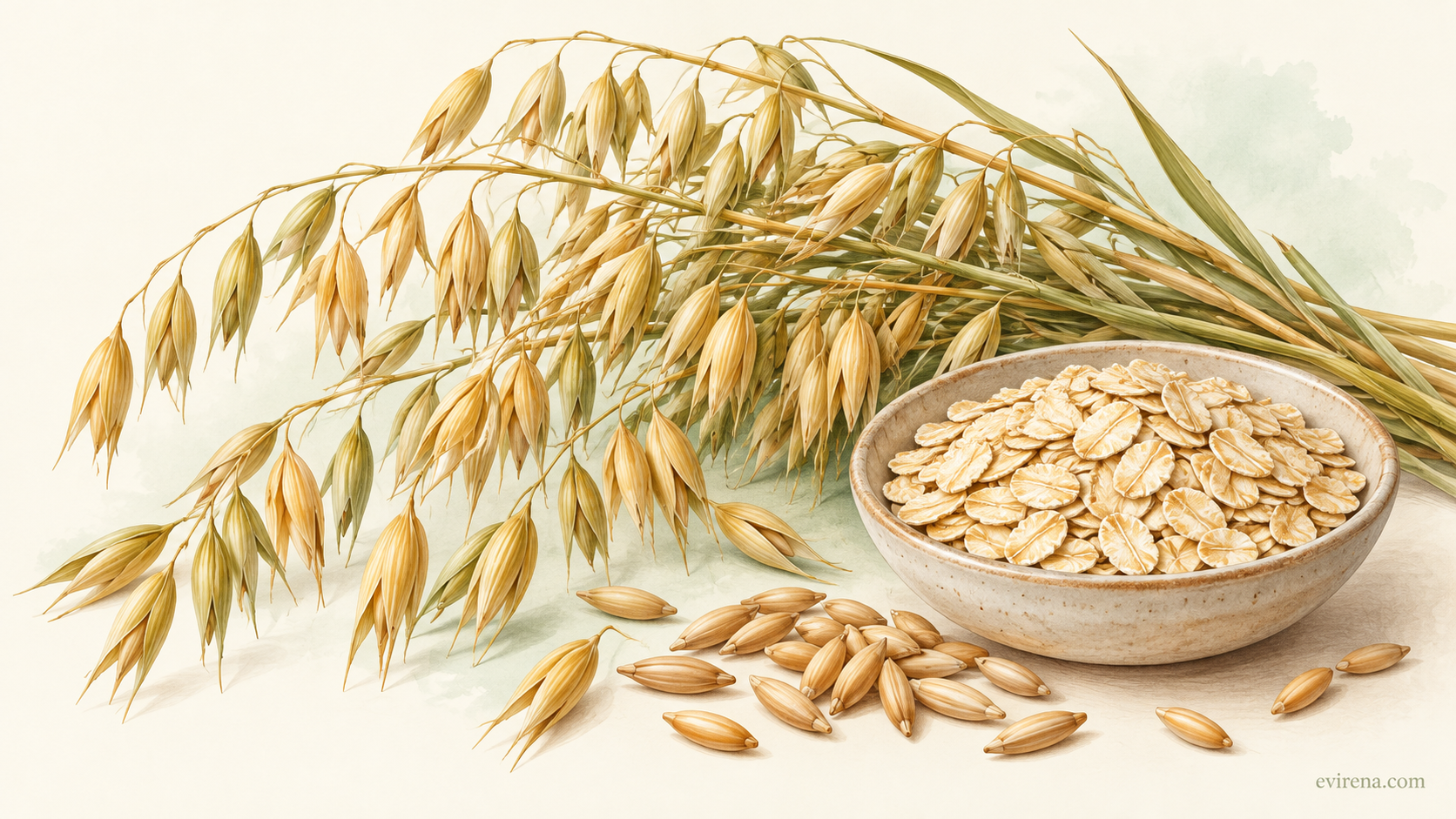
A cereal grain with a botanical identity
Common oats are the edible grain of Avena sativa, an annual plant in the grass family, Poaceae. The harvested grain is the part used in porridge and baking. Oat straw and extracts marketed under the same botanical name are different preparations; evidence about a grain food cannot automatically support claims for them. NC State's botanical profile identifies oats as both a food crop and a forage or cover crop. Botanical identity.
What the kitchen forms have in common
A groat is the oat kernel after its inedible outer hull is removed. Steel-cut oats are pieces of that kernel; rolled oats have been steamed and flattened. Oat bran is a separated fraction, while oat flour is milled grain. These forms differ in texture and cooking time. Porridge, a savoury grain dish and baking are ordinary food uses, without any treatment claim. Check a packaged product's ingredients: an oat-containing sweetened cereal is not interchangeable with plain oats. Follow its preparation and storage directions. Food forms.
What a cholesterol trial actually tested
Beta-glucan is a soluble fibre in oats. Its amount alone does not describe how a finished product behaves. In a four-week, randomized trial reported in 2010, 367 adults with raised LDL cholesterol were enrolled and 345 completed the study. Participants received a wheat-fibre control cereal or extruded cereals providing 3 or 4 grams of oat beta-glucan daily, with different molecular weights. Some high- and medium-molecular-weight preparations lowered LDL by about 4.7–6.5% compared with control; the low-molecular-weight preparation did not produce a statistically significant difference. Those quantities describe the experiment, not a personal intake recommendation. Original trial.
The result supports a modest, short-term effect of particular preparations. It does not establish that every bowl, drink or supplement has the same effect, or that eating oats prevents a heart attack. LDL was a laboratory outcome; the study did not measure long-term cardiovascular events. Product processing, the comparator and the people studied matter when interpreting a health claim.
Concentrated fibre is a separate exposure
A smaller six-week trial analyzed 75 adults with raised cholesterol after enrolling 90 and excluding 15 whose baseline cholesterol no longer met eligibility. It compared a powdered oat-bran concentrate supplying 6 grams of beta-glucan daily with dextrose. LDL fell more with the concentrate, but participants reported increased flatulence. The total-cholesterol difference between groups was not statistically significant. This study excluded users of several medicines, including cholesterol-lowering drugs; it does not demonstrate compatibility with those treatments or establish concentrate safety during pregnancy. Do not replace prescribed care with an oat product on the basis of these results. Concentrate trial.
Coeliac disease, contamination and allergy
Oats can acquire wheat, barley or rye contamination during growing or processing. For someone with coeliac disease, choosing oats specifically labelled gluten-free addresses an important contamination risk, but personal tolerance still needs attention. University food guidance.
An original study of nine deliberately selected adults with coeliac disease investigated immune responses to avenin, an oat protein. It documented intestinal inflammation and avenin-reactive immune cells in some participants. This small, non-random series establishes that oat intolerance can occur; it cannot tell us how common it is among all people with coeliac disease. Discuss introducing oats and persistent symptoms with the treating team. Avenin study.
Food allergy is a different issue. In research involving 302 children with atopic dermatitis referred for allergy testing, 5 of 32 oat-sensitized children who underwent an oral food challenge reacted. Sensitization on a skin test is not itself proof of food allergy, and these selected children do not represent the general population. A gluten-free label does not remove oat proteins: people with a confirmed oat allergy should avoid oat-containing products as advised by their allergy team. Original allergy research.
A practical reading of the evidence
Oats offer a versatile grain food. Their beta-glucan research is useful when the tested preparation and its limits remain visible. Choose the food for its culinary role and suitability, distinguish it from concentrated supplements, and treat coeliac disease or allergy precautions as part of that choice. This information explains evidence; it does not diagnose illness or provide an individualized dose.
Summary
Understand oat grain and its kitchen forms, what short cholesterol trials actually tested, and why concentrated fibre, coeliac disease and oat allergy need separate consideration.
Important note
With coeliac disease, use oats specifically labelled gluten-free and discuss tolerance or persistent symptoms with your treating team. A gluten-free label does not remove oat proteins. Avoid oat-containing products if you have a confirmed oat allergy, following your allergy team’s advice. Concentrated oat beta-glucan can cause flatulence. The cited trials do not establish its safety during pregnancy or compatibility with all medicines. Study quantities are not a personal dose. Do not replace prescribed treatment with oats or a fibre supplement.
This article provides educational information and does not replace advice from a qualified healthcare professional.
Sources and references
- The Molecular Basis for Oat Intolerance in Patients with Celiac Disease · Read source — PLOS
- Oats · Read source — Harvard T.H. Chan School of Public Health, The Nutrition Source
- Oat sensitization in children with atopic dermatitis: prevalence, risks and associated factors · Read source — Wiley
- Avena sativa (Oats) · Read source — North Carolina State University, Extension Gardener Plant Toolbox
- Concentrated oat β-glucan, a fermentable fiber, lowers serum cholesterol in hypercholesterolemic adults in a randomized controlled trial · Read source — Nutrition Journal
- Physicochemical properties of oat β-glucan influence its ability to reduce serum LDL cholesterol in humans: a randomized clinical trial · Read source — American Journal of Clinical Nutrition